Table of Contents
Learning to drive is a major milestone for both teenagers and adults in the United States. It typically takes a combination of study, practice, and time to become a safe, licensed driver.
Learning to drive isn’t something that happens overnight. How long does it take to learn how to drive? The time it takes to go from a complete beginner to a confident licensed driver varies widely from person to person. Factors like your age, the type of car (automatic vs. manual), how often you practice, and even your confidence level all play a role. Below, we break down the typical learning timeline, the licensing process for teens and adults, and what skills you’ll need to master along the way.
How Long Does It Usually Take to Learn to Drive?
There’s no single correct answer, but most new drivers can expect to spend at least a few months learning and practicing before they are ready for the road test. One commonly cited estimate is that becoming a competent driver requires around 45 hours of professional lessons plus 20 hours of additional practice, spread out over about 3 to 4 months. In practice, many American learners accomplish those hours through a mix of formal driver’s education and informal practice with family or friends.
Keep in mind this is an average – individual experiences differ. Some people who practice very frequently (almost daily) might be test-ready in a shorter period, while others who can only practice on weekends or who feel nervous may take longer. The goal is not to rush the process, but to make sure you log enough hours behind the wheel to feel comfortable handling a car in various situations. In the U.S., state laws often enforce a minimum practice period for teens (for example, a 6-month learner’s permit phase is common), which inherently spreads the learning over several months.
Even without legal waiting periods, it’s wise to give yourself time to absorb the skills. Remember that learning to drive involves both knowledge (rules of the road) and skill (vehicle handling) – both take time to develop.
Teen Drivers: Graduated Licensing and Learning Curve

For teenagers learning to drive in the U.S., the process is structured by graduated driver licensing (GDL) laws. This means there are multiple stages – typically a learner’s permit, an intermediate (provisional) license, and then a full license. Here’s what the timeline often looks like for a teen driver:
- Learner’s Permit (Written Test): Most states allow teens to get a learner’s permit around age 15½ to 16 after passing a written knowledge exam on traffic rules. Preparing for this written permit test usually involves studying the state’s driver handbook and taking practice tests. Many teens take a formal Driver’s Ed course (often required) which helps prepare for the written test. For example, California requires teens to complete 30 hours of driver education (classroom or online) before they can get a permit. This studying and coursework might take a few weeks to a couple of months to complete.
- Supervised Driving Practice: Once the permit is obtained, a teen must practice driving under supervision (usually with a parent or instructor in the passenger seat). State laws set a minimum number of behind-the-wheel practice hours. A common requirement is about 50 hours of supervised driving, including some night driving. In California, for instance, teens must log at least 50 hours (with 10 hours at night) before taking the road test.
These hours are typically accumulated over a minimum permit-holding period (often 6 months in many states for under-18 drivers). In practice, many teens spread their practice over that six-month period, driving a few hours each week under various conditions.
- Driver’s Education and Instructor Lessons: In addition to practicing with parents, most teens also take professional driving lessons. Many states mandate a set number of hours with a certified driving instructor (commonly around 6 hours of behind-the-wheel training with an instructor, broken into several lessons).
This training is often scheduled over weeks or months. For example, a teen might do one lesson per week for six weeks. The instructor ensures the teen learns proper techniques (like correct mirror use, smooth braking, and defensive driving strategies). All these lessons and practice sessions contribute to the total learning time.
- Road Test and Provisional License: After meeting the above requirements and reaching the minimum age (usually 16 or 17, depending on the state), the teen can take the road test (also called the driving skills test). The scheduling of the road test can add some time – in busy areas you might need to book it a few weeks in advance. Once ready, the teen takes the road exam, which usually lasts around 15–20 minutes of driving with an examiner.
If they pass, they receive a provisional or intermediate license (which often comes with some restrictions, like no late-night driving or no teenage passengers for a period of time). If they don’t pass, they’ll need to practice more and typically wait a short period (often a week or two) before retaking the test.
In total, a teenager who starts the process as soon as legally allowed will often spend a minimum of 6 months learning before they are fully licensed (and it could be longer, especially if they start later or need more practice). For example, a teen might get a permit at 15½, practice for six months, and take the road test at 16. During that time, they’ll likely have completed the required education course, done the instructor sessions, and accumulated 50+ hours of driving. Bottom line for teens: from the day you pass your written test, expect about half a year of regular practice and training before you’re driving on your own. This built-in timeline helps ensure young drivers have plenty of experience under their belt.
Adult Learners: Learning to Drive Later in Life
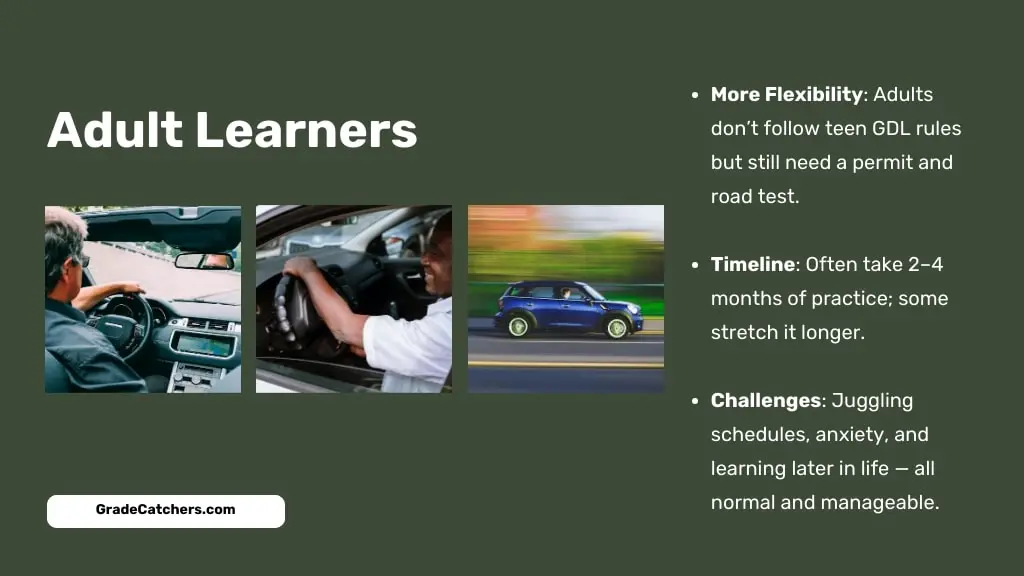
Not everyone learns to drive as a teen. In fact, about 18% of people wait until later in life (their 30s or 40s) to start learning to drive. If you’re an adult learning to drive, the overall skills you need to learn are the same, but the process and timeline can look a bit different:
- Fewer Mandatory Steps: Once you’re 18 or older, most states do not require formal driver’s ed courses or months-long permit periods the way they do for teens. You will still need to get a learner’s permit by passing the written knowledge test, but as an adult, you might not be required to hold that permit for a full 6 months.
In some states, you could theoretically take the driving test just days or weeks after getting your permit – if you feel ready. (For example, in California, an adult permit holder isn’t bound by the 6-month rule that minors have, and in some states like Virginia, an adult can skip driver’s ed by holding a permit for 60 days instead.) That said, practical learning time is still essential – even if the law doesn’t force you to wait, you’ll want to practice enough to pass the road test and be safe on the road.
- Scheduling Practice: Adult learners often have to juggle practice with work, family, and other responsibilities. One challenge can be finding the time to practice consistently. You might take lessons on weekends or drive with a friend or spouse in the evenings. This can sometimes stretch out the learning timeline compared to a teenager who might practice more regularly after school.
Be patient and plan ahead to fit in regular driving practice sessions. Some driving schools offer intensive courses for adults (for example, a week-long “crash course” where you do many hours of driving in a short span). These can accelerate the learning process if you’re in a hurry, but not everyone can handle or schedule such intensive training.
- Confidence and Nerves: Adults learning to drive may approach it with more caution, which is perfectly okay. It’s common to feel anxious starting to drive later in life. You might be very aware of the risks, which can actually make you a safer driver eventually, but it could take a bit longer to build confidence. “Learning to drive may take a bit longer now, so be patient with yourself,” advises driver safety experts for older adults.
The good news is that as an adult, you likely have more life experience to draw on. You’ve spent years as a passenger observing traffic, and you generally have a mature understanding of rules and consequences. This base of road knowledge can help – many older students already have a sense of road etiquette and what not to do (after years of seeing others drive). Plus, older learners tend to be less rash; they take safety seriously. Use those advantages, but also accept that mastering the physical skills (steering, parking, timing in traffic) will still require practice.
- Timeline for Adults: Because there’s no fixed program, the time it takes an adult to learn varies even more. If you can dedicate a lot of time (say hours of practice every day or two), you might become test-ready within a month or two. More commonly, adults spread lessons over several months. For instance, you might do an hour-long lesson once a week for a few months, plus additional practice drives with a family member on weekends.
After, say, 8–12 weeks of that routine, many adults feel prepared for the road test. Others might take six months or more – especially if they started very anxious or had long gaps between driving sessions. The key is consistent practice and gradually pushing yourself to try more challenging driving scenarios as you improve. There’s no shame in taking longer if you need it; the goal is to become a safe driver, not just to pass the test.
Automatic vs. Manual: Does Transmission Type Affect Learning Time?
When it comes to learning time, the type of car you use — automatic or manual (stick shift) — can make a difference. Most Americans learn to drive on an automatic transmission, and for good reason: the vast majority of cars in the U.S. are automatic, which “makes life easy, as you can slip the car into ‘Drive’ and not worry about the gears.”
With an automatic car, a new driver can focus on steering, accelerating, braking, and traffic conditions without the added complexity of shifting gears.
Learning on an automatic transmission is generally easier and quicker for most people. You don’t have to coordinate using a clutch pedal or time your gear changes. This means you can pick up the basics of starting, stopping, and maneuvering the car faster. Many driving instructors will start beginners on an automatic for this reason. In fact, choosing to learn on an automatic can shorten your practice time compared to learning on a stick shift.
On the other hand, learning to drive a manual transmission (stick shift) introduces a separate learning curve for operating the clutch and gears. You have to learn to shift at the right time and to start and stop without stalling. This does add some practice time. One driving school estimates that getting comfortable with the mechanics of a manual car might take roughly 20 days of daily practice (about an hour each day) to reach a point where gear changes are smooth and second-nature.
Of course, those 20 hours of practice aren’t only about the transmission – you’re simultaneously learning all the normal driving skills – but the point is that managing the gears requires extra focus and repetition. Early on, a lot of your mental bandwidth will go into remembering to clutch and shift, which can slow down how quickly you absorb other driving tasks.
With a manual, you might spend the first few lessons just working on starting, stopping, and shifting in a parking lot until you stop stalling the car. In contrast, an automatic allows you to move on to traffic sooner. So if your goal is to get licensed as quickly as possible, an automatic is usually the faster route. In the U.S., your license isn’t restricted by transmission type – if you test in an automatic, you’re still legally allowed to drive a manual (though you’d have to learn how on your own later). So many people simply get their license in an automatic and worry about learning stick shift only if they ever need to (such as driving a sports car or traveling abroad where manual cars are common).
That said, learning to drive on a manual is certainly achievable; it just may take a bit more time and patience. Some learners actually prefer to do a few lessons on an automatic to grasp basic driving, and then take additional lessons to learn the stick shift mechanics. Ultimately, whether you choose automatic or manual, you’ll need to be comfortable with the vehicle you plan to drive regularly. For most Americans, that’s an automatic – convenient and one less thing to think about – but if you do invest time in learning a manual, you’ll gain a skill that can make you a more versatile driver (and impress your friends!).
Key Driving Skills to Master (Parking, Merging, Freeway Driving, etc.)
Regardless of age or transmission type, every new driver has to master a core set of driving skills. How quickly you become proficient in each of these areas can influence the overall time it takes to learn to drive. Here are some of the critical skills and milestones in the learning process:
- Basic Vehicle Control. The first thing you’ll learn is how to control the car’s basic functions. This includes starting the car, using the gas and brake pedals smoothly, steering control, and coming to a controlled stop. In an automatic, these basics can be picked up in the first couple of lessons. You’ll also learn to adjust your mirrors, use your turn signals, and get a feel for the size of your vehicle. These foundational skills are usually the easiest part – most people get a handle on them within a few hours of practice, though perfecting smooth acceleration and braking can take more time.
- Parking and Low-Speed Maneuvers. Parking tends to be one of the more challenging skills for new drivers, especially parallel parking. It requires good spatial awareness and vehicle positioning. Many U.S. driving tests include a parallel park or a three-point turn (or both), so you’ll need to practice these. At first, parking between cones or in an empty parking lot helps you get the hang of it. Don’t worry if it’s hard at first – many people struggle with parallel parking initially.
With repeated practice, you’ll learn how to gauge distances and angle the car. Other parking skills include backing into a parking space and pulling into tight spots in parking lots. Mastering parking could take dozens of tries over several practice sessions before you feel comfortable doing it on the first attempt. Give it time – even experienced drivers occasionally need a couple of adjustments to park perfectly.
- Navigating Intersections and City Driving. Driving on regular streets means dealing with stop signs, traffic lights, and understanding right-of-way rules at intersections. New drivers practice coming to complete stops, judging when to make a turn across traffic, and being cautious of pedestrians. City driving also means handling distractions and complex situations (like road construction or emergency vehicles).
These skills build gradually as you drive in different areas. Starting on quiet residential streets and then moving up to busier roads is a common progression. It might take a month or more of practice before a beginner feels at-ease driving through a bustling downtown area during moderate traffic. Each new scenario (your first four-way stop, your first unprotected left turn across oncoming cars, etc.) is a learning experience.
- Lane Changes and Mirror Use. Changing lanes on multi-lane roads and using mirrors effectively is another key skill. Beginners often find lane changes intimidating – you have to check mirrors and blind spots, judge the speed of cars behind you, and move smoothly. You’ll practice this on roads with light traffic at first. Developing the habit to “check your mirrors, signal, check your blind spot, then move” takes repetition. After some practice, this becomes second nature, but it might feel like a lot to juggle initially. Give it a few weeks of practice in various traffic conditions to get comfortable with lane changes.
- Merging onto Highways and Freeway Driving. Entering a freeway (interstate highway) for the first time can be nerve-wracking for new drivers. Speeds are higher, and you have to merge into fast-moving traffic. Typically, an instructor or parent will introduce highway driving after you’ve got a solid grasp of controlling the car at lower speeds. The key is learning to use the on-ramp to get up to the speed of traffic and finding a safe gap to merge into. It may take a number of tries on different days to feel comfortable merging.
Once on the highway, you’ll also learn maintaining highway speeds, keeping safe following distances, and dealing with large trucks or buses. Freeway driving also involves lane discipline and knowing when to change lanes (for instance, to move out of a lane that’s ending or to pass a very slow vehicle safely). After a few sessions of highway practice, most learners start acclimating to the speed.
Still, it can take a while before highway driving feels as relaxed as driving on a quiet street. Confidence at high speeds is usually one of the later things to develop, often after you’ve been driving for a few months. Many new drivers initially prefer to avoid highways until they’ve gained more experience.
- Defensive Driving. Being a safe driver is not just about executing maneuvers, but also about adopting a defensive mindset. Defensive driving means anticipating potential hazards and the actions of others on the road. As you learn, your instructor or parent will likely coach you to “keep your eyes moving” – checking mirrors regularly, scanning far down the road for brake lights or obstacles, and watching out for erratic drivers. You’ll learn to maintain a safe following distance (so you have time to react if the car ahead stops suddenly) and to cover your brake when you see a situation that might require a slow-down.
Beginners tend to be very focused on their own actions (like “Am I in the center of my lane? Is my speed okay?”), but with practice you start to widen your awareness to everything happening around you. Good driving courses and handbooks emphasize defensive techniques from day one, but truly internalizing them comes with experience. As you log more hours, you’ll start noticing hazards quicker and reacting more calmly – that’s defensive driving skill growing. It’s an ongoing learning process, even beyond getting your license.
- Driving in Various Conditions. To be fully prepared, you should practice in different conditions: night driving, rain, maybe even snow if applicable, and light vs. heavy traffic. Each of these adds difficulty. Night driving, for example, challenges your visibility and depth perception. In fact, new drivers are often advised to stick to daytime driving at first and only tackle night once they’ve got basic skills down, since driving in the dark is challenging even for experienced drivers.
Likewise, a rainy day will affect braking and require more caution. During your learning phase (especially if it spans a few months), try not to avoid these conditions altogether – you need to experience them at least a few times with an instructor or parent, so you won’t be caught completely off-guard once you’re licensed. Many states recognize this by requiring a portion of the supervised driving hours to be at night or in inclement weather. For example, New York mandates that out of the 50 practice hours, 15 hours must be after sunset (night driving practice). The more scenarios you experience while learning, the more well-rounded and prepared you’ll be.
As you can see, becoming a competent driver involves mastering a whole set of skills step by step. Some skills will come easier to you than others. You might nail your parallel parking but find highway merging scary for a while, or vice versa. It’s normal. The learning process is about gradually building up all these abilities. A structured approach helps: start with the basics in an empty lot, then quiet streets, then busier roads, then highways, and so on. By the time you’re ready for your road test, you should have practiced all of the above at least enough to handle them under exam conditions. Keep in mind that even after you pass the test, you’ll continue to improve these skills with solo driving (more on that later).
Factors That Influence How Quickly You Learn
Why do some people seem to learn to drive in a few weeks while others take a year? There are many individual factors that affect your learning curve behind the wheel. Understanding these can help set realistic expectations and allow you to adjust your learning approach:
- Age and Learning Ability. Age can play a role in learning speed. Teenagers often pick up the coordination and muscle memory for driving relatively quickly – youth can be an advantage in learning new motor skills. However, teens might lack caution or underestimate risks. Older learners (in their 30s, 40s, 50s) may take a bit more time to build those reflexes and confidence, but they often compensate with maturity and focus. It’s worth noting that plenty of older first-time drivers succeed – they might just need a little extra practice and patience. There’s nothing inherently “too late” about learning to drive; it’s more about how much time you can devote and how comfortable you are.
- Previous Experience (or Lack Thereof). Any prior exposure to driving can help. Someone who grew up riding dirt bikes, ATVs, or even just go-karts might find car handling more familiar. Even non-driving experiences like bicycling in traffic (which teaches awareness of vehicles) or playing driving video games (which at least teach the basic concept of steering/braking, though not the physical feel) can give a tiny head start.
Conversely, if you’ve hardly ever been in a car or paid attention to how driving works, it may all feel completely foreign at first and take longer to get used to. Simply observing others drive over the years (like watching your parents as a passenger) can subtly help you absorb road rules and driver behavior, which might make the learning curve a bit smoother.
- Confidence vs. Anxiety. Your personal comfort level with new challenges will significantly impact learning speed. “If you are usually confident when exploring new skills, you may find it easier to pick up driving skills and feel comfortable behind the wheel more quickly. On the other hand, if you tend to be more cautious or anxious, it may take more time and practice to feel at ease while driving.”
In other words, a naturally confident person might be willing to drive in heavier traffic sooner or won’t be as rattled by mistakes, allowing them to progress faster. An anxious learner might need more repetition and reassurance for each new step. Both approaches are okay. If you are anxious, it can help to communicate this with your instructor – a good teacher will make sure to go at a pace that doesn’t overwhelm you. Over time, with patient practice, even nervous drivers do gain confidence. But it’s clear that mental state and fear (or lack of it) will influence how quickly you’re willing to tackle new driving situations.
- Frequency of Practice. This is a big one. Learning to drive is very much a “practice makes perfect” skill. If you practice driving regularly – say multiple times a week – you’re going to progress faster than someone who drives only once every couple of weeks. Each practice session reinforces and builds on the last. Long gaps between sessions can set you back a bit, as you spend time relearning things you forgot.
Consistency helps your brain and muscles retain the skills. Think of it like learning a musical instrument: daily or weekly practice yields faster improvement than very sporadic practice. When possible, try to drive at least a few hours each week when you’re learning. If your schedule is tight, even a short 30-minute drive with a licensed friend on a weeknight can keep your skills sharp between longer lessons on the weekend.
- Quality of Instruction. Who teaches you can also affect how quickly you learn. A professional driving instructor or a calm, experienced family member can teach you proper techniques from the start and instill good habits, which might help you learn more efficiently. If, on the other hand, you’re being taught by someone who is impatient or not very knowledgeable about current rules (say, a friend who gets frustrated or a relative who hasn’t actually read the manual in decades), you might find the learning environment stressful or pick up some bad habits that need correcting later.
A supportive, knowledgeable teacher can boost your learning speed by making each lesson effective. Don’t hesitate to switch instructors or ask for a different approach if you feel you’re not progressing.
- Learning Environment. The driving environment where you practice can influence your comfort and speed of learning. For example, heavy urban traffic and complex road systems can be overwhelming for a beginner, potentially slowing the early stages of learning. In contrast, practicing in a quiet suburban neighborhood or rural area with simple roads might allow you to build basic skills faster with less stress. If you live in a big city, consider starting your practice drives at off-peak hours or in calmer areas before gradually working up to rush-hour downtown driving.
The variety of environments is also important: once you’ve got basics down in the parking lot, you will want to challenge yourself with busier roads so you can continue to improve. But it’s true that someone learning in a small town might feel comfortable sooner simply because the driving scenarios they face are less intense than those in a major city. Ultimately, you have to learn to handle all kinds of roads, but adjusting the order and timing (easy environments first, hard ones later) can affect how your learning progresses.
- Personal Aptitude and Reflexes. Individuals differ in hand-eye coordination, reaction time, and the ability to multitask – all relevant to driving. Some people are naturally adept at judging distances and speeds; they might have an easier time merging or parking. Others might need more practice to develop those spatial judgments. Young people steeped in multitasking on devices might find they still need to train their focus on the road (driving requires constant attention, and that’s a skill in itself).
There’s also the aspect of memory – remembering all the rules and steps (mirrors, signals, etc.). If you’re a quick study with cognitive tasks, the rules of the road will click faster; if not, you might need to review the handbook more. The good news is driving skills aren’t fixed traits – everyone improves with practice, and any initial “aptitude” differences tend to even out after enough hours behind the wheel.
In summary, many factors affect how quickly you learn to drive. Two siblings of the same age can start at the same time and still end up taking different amounts of time to feel ready for their license, simply because one was more anxious or didn’t practice as much, for example. Recognize where you might need to put in extra effort – if you can only drive on weekends, accept that it might take a bit longer, or if you’re very nervous, plan for more short practice drives to build confidence. There’s no race; what matters is becoming a capable and safe driver in the end.
Becoming a Confident and Safe Driver: After You Get Your License
Getting your driver’s license is a huge achievement – but it’s not the end of the learning process. Driving is a skill that continues to develop over time, especially in the first year or two of solo driving. So, how long does it take to learn how to drive anywhere, anytime? Experienced instructors often say that it’s going to take about six months of regular driving on your own to establish confidence in your driving skills and ability to handle any setting – whether it’s driving at night, in bad weather, or on a busy highway.
In other words, even after you “learn to drive” and pass the test, the first half-year of independent driving is when you truly solidify your skills and grow from a new driver into a seasoned driver.
During those first months with a license, you’ll likely encounter new situations that you didn’t face during supervised practice. For instance, your first long road trip on your own, or the first time dealing with an aggressive driver without an instructor there to guide you. Each of those experiences will build your confidence. It’s a great idea to gradually expose yourself to new challenges.
If you’ve avoided highways or nighttime driving up to now, start easing into those: maybe drive on the highway for one exit during daylight with a licensed friend along, or do a short drive at dusk. Step by step, you’ll expand your comfort zone. By six months in, if you drive consistently, you’ll find things that seemed intimidating at first (like merging or downtown parking) feel much more routine.
Another aspect of becoming truly safe on the road is continuing to practice defensive driving habits. Consider taking a defensive driving course or an advanced driving class after you get some solo experience; courses offered by groups like AAA or AARP (for older drivers) can provide additional training in hazard avoidance, and they often lead to insurance discounts as a bonus. Even simply reflecting on your driving and asking more experienced drivers for tips can be valuable. Importantly, never stop learning.
Laws and recommendations can update (for example, new technology in cars or changes in traffic law), and our driving environment is always evolving. Seasoned drivers keep their skills sharp by staying focused and not becoming complacent. As a new driver, if you ever feel unsure about something (say, how to drive in heavy snow, or the best way to handle a skid), seek out that knowledge proactively.
Give yourself those first 6-12 months of driving solo to gain full confidence. Over time, driving will become second nature. You’ll find you can relax a bit more (while still staying attentive) and even handle distractions better. The anxious checklists in your head (“mirror, signal, shoulder check, go”) will turn into habits you do automatically. This is the stage where you can truly say you’ve “learned how to drive” in the fullest sense – not just enough to get licensed, but enough to feel comfortable and safe in virtually any common driving scenario.
The Bottom Line
So, how long does it take to learn how to drive? For most people in the U.S., you’re looking at a commitment of at least a few months from the start of learning to the day you confidently drive on your own. In terms of hours, that might mean on the order of 40 to 60 hours of practice behind the wheel (amassing experience in different conditions) before you reach a solid level of competence. Teenagers will typically spend 6+ months due to permit requirements, while motivated adults might shorten that with intensive practice, but often it still ends up being a multi-month process.
Keep in mind that everyone learns at their own pace. Don’t be discouraged if it’s taking longer than you expected – what matters is building skill and confidence. Driving is a complex activity, and the stakes (your safety and others’) are high, so it’s worth the time investment. Follow your state’s licensing process step by step, get plenty of practice in, and focus on learning from each drive rather than just “getting it over with.”
Whether you’re 16 or 60, with steady effort you will get there. And when you finally do earn that driver’s license, you’ll know it wasn’t luck – it was all those hours of preparation paying off. Safe driving!