Table of Contents
How long does it take to learn Arabic? This common question doesn’t have a one-size-fits-all answer. In fact, how long does it take to learn Arabic varies widely from person to person. Learning Arabic can take anywhere from a few months for basic conversational skills to several years for full fluency. It depends on many factors, including your goals, study methods, and the type of Arabic you want to learn.
How Long Does It Take to Learn Arabic for Beginners and Travelers?
If you’re a beginner or learning Arabic for travel, your goal might be basic communication rather than full fluency. So, how long does it take to learn Arabic at a survival level? For most beginners focusing on practical phrases, you can achieve basic conversational ability in a few months to around one year of consistent study.
A first milestone is the Arabic alphabet – with regular practice, you can learn the alphabet in as little as 1 to 3 weeks. The next step is everyday phrases. Many travelers find that after approximately 6 months of study, they can handle routine interactions like greetings, shopping, and asking for directions. In fact, you don’t need to be fluent to get by – even a low-intermediate level can get you pretty far in Arabic-speaking countries. Locals will definitely appreciate your effort in speaking their language, and knowing some key phrases will greatly enhance your trip.
Modern Standard Arabic vs Dialects
Arabic has many dialects (like Egyptian, Levantine, Gulf, Maghrebi) that differ from the formal Modern Standard Arabic (MSA). If you plan to live in a specific country, learning its dialect will help you in daily conversation. However, how long does it take to learn Arabic remains roughly the same whether you focus on MSA or a local dialect – you’ll need a similar amount of time to reach a conversational level.
Arabic learning timeline by goal (MSA + reality check)
| Goal (CEFR) | What you’ll be able to do | Est. total hours* | If you study 30 min/day | If you study 1 h/day | With immersion (20–30 h/week) |
| Travel survival (A1) | Read Arabic script basics, greet, order food, ask directions, numbers, and prices | 60–90 | 4–6 months | 2–3 months | 3–5 weeks |
| Beginner conversational (A2) | Simple small talk, transport, hotels, common verbs in present/past | 180–250 | 12–16 months | 6–8 months | 2–3 months |
| Strong conversational (B1) | Handle most travel tasks, describe plans, opinions, and everyday problems | 350–500 | 2–3 years | 12–16 months | 4–6 months |
| Comfortable daily/work (B2) | Follow news, meetings with support, narrate events, negotiate basics | 700–900 | 4–5 years | 2–2.5 years | 8–12 months |
| Professional working (C1) | Read newspapers/official docs, debate, and present with nuance | 1200–2200 | 7+ years | 3–6 years | 1–2 years |
*Estimates for English speakers. Arabic is generally considered a “super-hard” language; your timeline shrinks with consistency, speaking practice, and immersion.
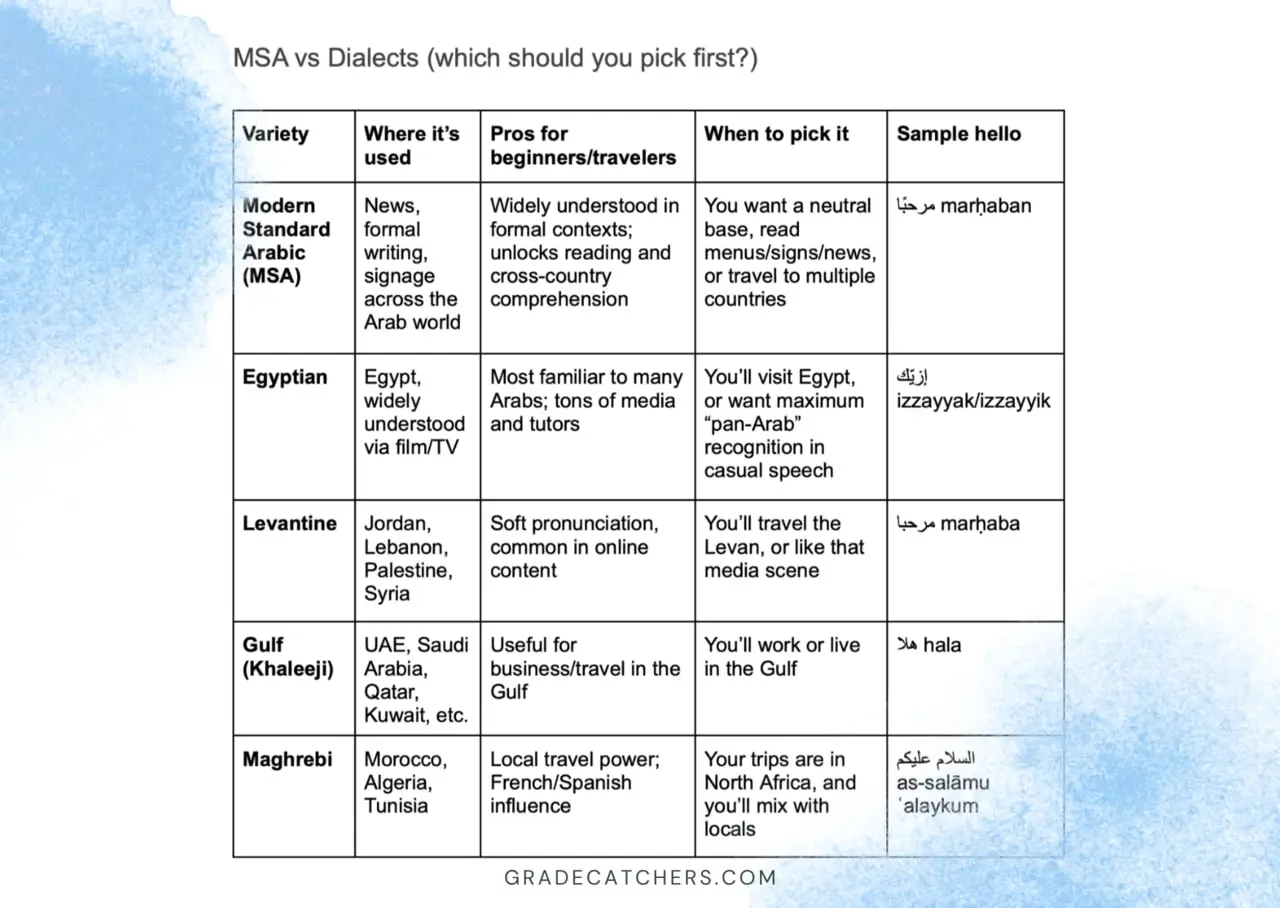
MSA vs Dialects (which should you pick first?)
| Variety | Where it’s used | Pros for beginners/travelers | When to pick it | Sample hello |
| Modern Standard Arabic (MSA) | News, formal writing, signage across the Arab world | Widely understood in formal contexts; unlocks reading and cross-country comprehension | You want a neutral base, read menus/signs/news, or travel to multiple countries | مرحبًا marḥaban |
| Egyptian | Egypt, widely understood via film/TV | Most familiar to many Arabs; tons of media and tutors | You’ll visit Egypt, or want maximum “pan-Arab” recognition in casual speech | إزيّك izzayyak/izzayyik |
| Levantine | Jordan, Lebanon, Palestine, Syria | Soft pronunciation, common in online content | You’ll travel the Levan, or like that media scene | مرحبا marḥaba |
| Gulf (Khaleeji) | UAE, Saudi Arabia, Qatar, Kuwait, etc. | Useful for business/travel in the Gulf | You’ll work or live in the Gulf | هلا hala |
| Maghrebi | Morocco, Algeria, Tunisia | Local travel power; French/Spanish influence | Your trips are in North Africa, and you’ll mix with locals | السلام عليكم as-salāmu ʿalaykum |
Tip: If your first trip is fixed, start with that dialect for speaking + a lightweight MSA reading track (alphabet, signs, numbers). If your itinerary spans several countries, start with MSA + Egyptian for broad coverage.
How Long Does It Take to Learn Arabic Fluently?
Many learners wonder how long does it take to learn Arabic to become fluent. Roughly, basic conversation can take around 6-12 months, an intermediate level around 2-3 years, and advanced fluency about 5 or more years. As a guide to how long does it take to learn Arabic, the U.S. Foreign Service Institute (FSI) estimates about 2,200 hours of study (approximately 1.5 years full-time) for professional working proficiency.
Arabic is categorized as a “super-hard” language for English speakers, which shows why it requires a significant time investment. Immersion can shorten that timeline dramatically: living in an Arabic-speaking country, you might get conversational in 3-6 months – dramatically cutting how long does it take to learn Arabic – whereas studying a few hours a week could take a couple of years to reach the same level.
Consistency is one of the biggest keys to success. Studying a little every day tends to beat sporadic long sessions. By following these tips, you can significantly reduce how long does it take to learn Arabic on your language journey.
Also, if you are interested in learning Polish – just read our article “Is Polish hard to learn“?
Tips to Learn Arabic Faster
- Immerse Yourself: Surround yourself with Arabic as much as possible. Watch or listen to Arabic media (TV, music, podcasts) frequently. Immersion will help you pick up common phrases and improve your listening comprehension naturally, which in turn reduces how long does it take to learn Arabic.
- Practice Speaking Regularly: The sooner you start speaking, the better. Practice out loud with whatever words you know. Find a language exchange partner or tutor online. Frequent speaking practice builds confidence and fluency, helping you become conversational faster and thus reducing how long does it take to learn Arabic.
- Be Consistent and Stay Motivated: Short daily study sessions beat infrequent cramming and keep your momentum, clearly shortening how long does it take to learn Arabic. Also keep your motivation high by celebrating milestones and enjoying the process. If you stay positive and persistent, you’ll find that how long does it take to learn Arabic matters far less than the progress you’re making.
FAQ
How long does it take to learn Arabic for travel?
2-6 months for A1 survival with 60-90 hours. Study 30-60 min/day and start speaking from day one.
Should I start with MSA or a dialect?
One country: the local dialect and light MSA for reading.
Multi-country/news: MSA first; optionally add Egyptian for broad casual understanding.
How many hours for conversational level?
B1: 350-500 hours.
1 h/day: approximately12-16 months. Immersion 20-30 h/week: approximately4-6 months. Consistency = faster gains.
Is the Arabic script hard?
Different, not hard. 1-3 weeks if you: learn letters in groups, practice joined forms, use spaced repetition, handwrite daily, and read short, real texts.
What mistakes slow learners down?
- Avoid speaking – do 2-3 short tutor/exchange sessions weekly.
- Skipping pronunciation – drill minimal pairs (ع، غ، خ، ح، ق).
- Only MSA or only dialect – blend to match goals.
- Inconsistent study – 30-40 min daily.
- Word lists without context – learn useful phrases.
Conclusion
So, how long does it take to learn Arabic? In general, reaching a basic level takes a matter of months, while achieving full fluency can take years. A dedicated learner can make a lot of progress in 6-12 months, and reaching an advanced level might take 5+ years (you’ll be functional well before that).
Ultimately, how long does it take to learn Arabic depends on the individual. With consistent effort and smart study, you can shorten how long does it take to learn Arabic significantly and make steady progress. Arabic is a challenging but rewarding journey, and every hour you invest brings you closer to your goal. Good luck on your journey – no matter how long does it take to learn Arabic, it’s worth it. And as they say in Arabic, بالتوفيق (bil-tawfiq)!