Table of Contents
Most beginners ask is guitar hard to learn because they picture endless scales and sore fingertips. The main point is that guitar is a coordination puzzle that becomes manageable fast if you focus on the right things – clean fretting, steady rhythm, and tiny wins you can stack daily.
When “Is Guitar Hard to Learn” Is The Wrong Question
The better question is: What’s the shortest path to my first song? Chasing speed or theory early can hide the joy of playing music. Set a near-term target (one song you love) and work backward.
| Weeks | Goal | Daily (min) | Do (key actions) | Checkpoint | Tip |
| 0–2 | Comfort + 4 open chords | 15–25 | Tune; learn G–Em–C–D. Strum D D U U D U. 60-sec loops G–Em, C–D @ 70–80 BPM | Map verse/chorus. Keep strumming on autopilot. Add bass-note pick. Loop hardest bar @ 50–60% speed | Use minimal pressure. Fret just behind the metal |
| 3–6 | First full song | 20–30 | Map verse/chorus. Keep strumming on autopilot. Add bass-note pick. Loop the hardest bar @ 50–60% speed | Verse + chorus @ 80–90 BPM. Weekly clip | Count “1-and-2-and”. Keep strumming through changes |
| 7–12 | Control + second song | 20–30 | Cycle G–C–D–Em. Add Am, D7. Muted hits on 2 & 4. +5 BPM only when clean. 5-min change drill | Two songs at target tempo. Smoother transitions | Slow until clean. Delay full barres until open chords are solid |
What Success Actually Looks Like
- A clear, visible goal. Play one full song with chords and strumming.
- A short daily slot. 15–25 minutes beats a two-hour weekend binge.
- A habit trigger. Same chair, same time, guitar on a stand – no case.
- A feedback loop. Record 30 seconds weekly to hear progress.
What Makes The Guitar Feel Hard
- Left-hand tension. Pressing too hard slows you down and hurts your tone.
- Right-hand rhythm drift. Strumming becomes inconsistent when you stare only at your fretting hand.
- Chord changes. Moving cleanly between G–Em–C–D is the first “wall.”
- Expectations. Comparing day 7 to your favorite artist kills motivation.
Quick Fixes
- Relax grip; use the minimum pressure that stops string buzz.
- Count out loud (“1-and-2-and…”) to anchor rhythm.
- Practice micro-loops: two-chord switches for 60 seconds each.
A 90-Day Plan That Works
You don’t need eight apps and a theory tome. You need structure, reps, and a song.
Source: JustinGuitar
Weeks 0–2: Foundation & Comfort
- Set up the guitar. Proper string height (action) and tuning.
- Build calluses safely. 15 minutes a day, max. Stop when tone degrades.
- Learn four chords. G, Em, C, D (or A, D, E if those feel easier).
- One strum pattern. Down-down-up-up-down-up. Keep it slow.
- Two-chord loops. G–Em and C–D, one minute each, repeat three times.
If friends ask is guitar hard to learn, show them a clean two-chord loop at 70–80 BPM and they’ll get it.
Weeks 3–6: First Full Song
- Pick one track that uses your chords (plenty of pop/folk choices).
- Map the structure. Verse, chorus, bridge. Write chord order.
- Strum on autopilot. Keep your right hand moving even if the left hand lags.
- Record weekly. 30 seconds, same section, same tempo.
- Add one skill. Simple bass note pick (thumb on low string) before each strum.
Weeks 7–12: Control & Expansion
- Smooth changes. 5 minutes of G–C–D–Em in a loop.
- Upgrade rhythm. Add muted “chick” on beats 2 and 4.
- New color. Learn Am and D7 to expand progressions.
- Tempo bump. +5 BPM each week only if tone stays clean.
- Second song with similar chords to cement muscle memory.
Smart Practice Habits That Actually Move the Needle
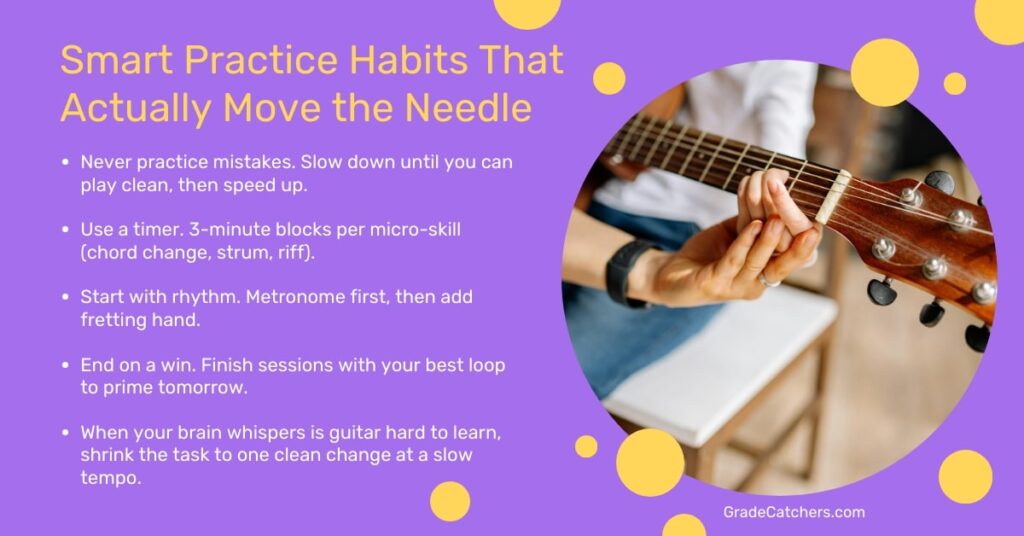
- Never practice mistakes. Slow down until you can play clean, then speed up.
- Use a timer. 3-minute blocks per micro-skill (chord change, strum, riff).
- Start with rhythm. Metronome first, then add fretting hand.
- End on a win. Finish sessions with your best loop to prime tomorrow.
- When your brain whispers is guitar hard to learn, shrink the task to one clean change at a slow tempo.
Common Roadblocks and Quick Fixes
- Finger pain. Short sets, lighter strings (e.g., .010s) help.
- Buzzing strings. Check fingertip placement – just behind the fret, not on it.
- Dead sound on barre chords. Ignore full barres for now, nail open chords first.
- Rhythm stalls on chord changes. Keep the right-hand strumming even if a chord arrives late. The groove matters more than perfection.
Gear That Helps (not required)
- Tuner (clip-on or app)
- Light/medium picks; try a few thicknesses
- A guitar stand to keep it visible
- Metronome app
Mindset. How to Stay Consistent
- Track minutes played, not “days missed.” Consistency compounds.
- Celebrate tiny upgrades. Less buzz, smoother G–C switch, steadier tempo.
- Find one accountability hook. A friend, a teacher, or a weekly open mic.
Learner Testimonials
“Week 2 was rough, then my G→C change clicked. I played my first song on day 19.”
Marta K.
“Recording short clips made progress obvious. By week 6 I sounded like… me, but musical.”
Andre P.
“I stopped white-knuckling the strings and my tone improved overnight.”
Lena S.
“Metronome at 72 BPM, daily. Boring, effective, confidence-building.”
Hiro T.
“Keeping the guitar on a stand doubled my practice. Visibility equals playability.”
Samir A.
FAQ
How long does it take to play a first song on guitar?
With 15–25 minutes of focused daily practice, most beginners can play a simple song in 3–6 weeks using four open chords and a basic strum pattern.
How much should a beginner practice each day?
Short daily sessions (15–25 minutes) work better than long weekly marathons. Use micro-blocks for chord changes, strumming, and transitions.
Do I need music theory to start?
No. Start with chord shapes and rhythm. Add theory later to understand why progressions work and how to write songs.
Should I start on acoustic or electric?
Play the instrument that makes you excited to practice. Electric is often easier on fingers early; acoustic builds finger strength quickly.
How do I reduce fingertip pain?
Keep sessions short, use lighter gauge strings, fret near the metal, and rest when tone degrades. Calluses form within 1–2 weeks.
Bottom Line
If you’re still wondering is guitar hard to learn, zoom in on the next small win: one chord change, one clean bar, one steady pattern. Stack those, and the question is guitar hard to learn fades into the background. By the end of 90 days, most beginners can strum full songs, keep time, and feel proud of the sound coming out of the amp – or the living room.
We have also collected a lot of interesting things in the How to Learn section. Come in!